

Redesign
iOS
Android
Overview:
ABOUT:
Veezu is a ride-hailing app focused on making journeys more reliable, accessible, and local for communities across the UK. Passengers can book a ride on demand or schedule in advance, with real-time updates throughout their journey.
Company:
@veezu
Launched:
July 2026
Role:
Senior Product Designer
Team:
Aleksei Provorov, Danilo Aliberti, Gus Ward
Intro
Whenever you book a taxi, there's always a small part of you wondering, will they actually arrive? Whether it's a 5am trip to Gatwick airport or getting to work during rush hour, waiting without knowing what's happening can be surprisingly stressful.
This was exactly the challenge I faced at Veezu. When booking a ride, passengers were placing their trust in the app to find a driver — but the experience provided little reassurance while they waited.
My role was to redesign the booking journey around the moments that mattered most to passengers, making key system states visible and helping them understand what was happening from requesting a ride all the way to arrival.

Before — The original experience used a single, continuous progress bar, which left passengers feeling like nothing was happening
Behind the scenes, much more was happening than passengers could see. The app was searching for nearby drivers, offering the job, handling delays, calculating routes and updating arrival times — all while the interface remained static.
The challenge wasn't to redesign a loading state — it was to build trust by making an invisible system feel visible.
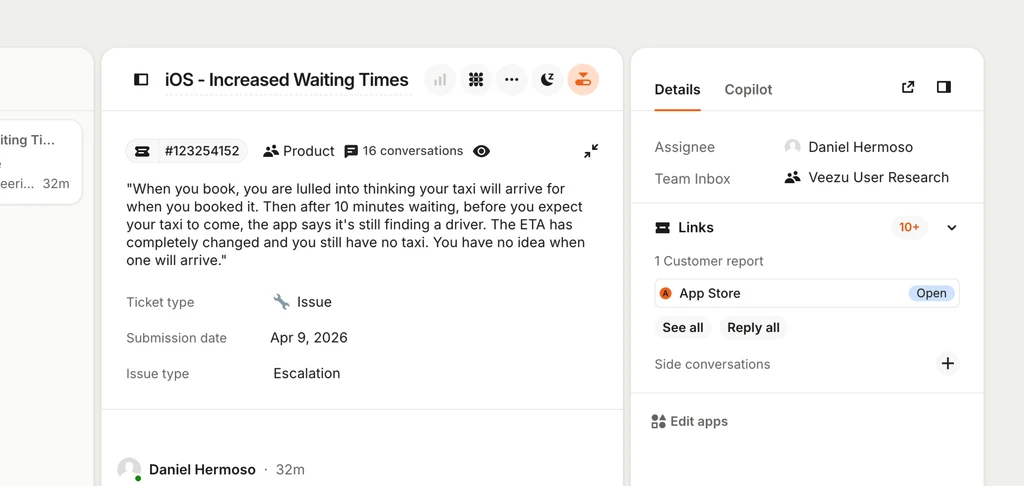
Our support team was regularly receiving requests from passengers confused by extended wait times
The cost of uncertainty
This confusion had a wider business impact. 80% of unsatisfied demand in the app was caused by cancellations. With acceptance rates as low as 30%, driver matching could take longer, but passengers had no visibility into this process. Without seeing progress, uncertainty grew and passengers were more likely to cancel before a driver was matched.
For new passengers using Veezu for the first time, this created a poor first impression at the most important moment of the journey — before they had even completed their first ride.
BUSINESS GOAL:
Improve passenger trust, reduce avoidable cancellations, lower support requests, and improve first-ride retention.
Redesigning the booking experience
Every decision was guided by three key principles: meaningful progress to remove guesswork, a transparency-first approach that stays honest even when things don't go as expected, and human connection that brings drivers and passengers closer before the ride begins.

Each step used a subtle pulse or loading state to show that the system was actively working, while completed stages provided a clear sense of progress
Making progress visible
To make the booking experience feel more transparent, I introduced a contextual progress bar. This required mapping the passenger journey alongside the system states and iCabbi data to understand what was happening at each stage and where we could provide more visibility.
Not every system state needed to be surfaced. The steps we highlighted needed to be useful, timely and give passengers a clear sense of what was happening.

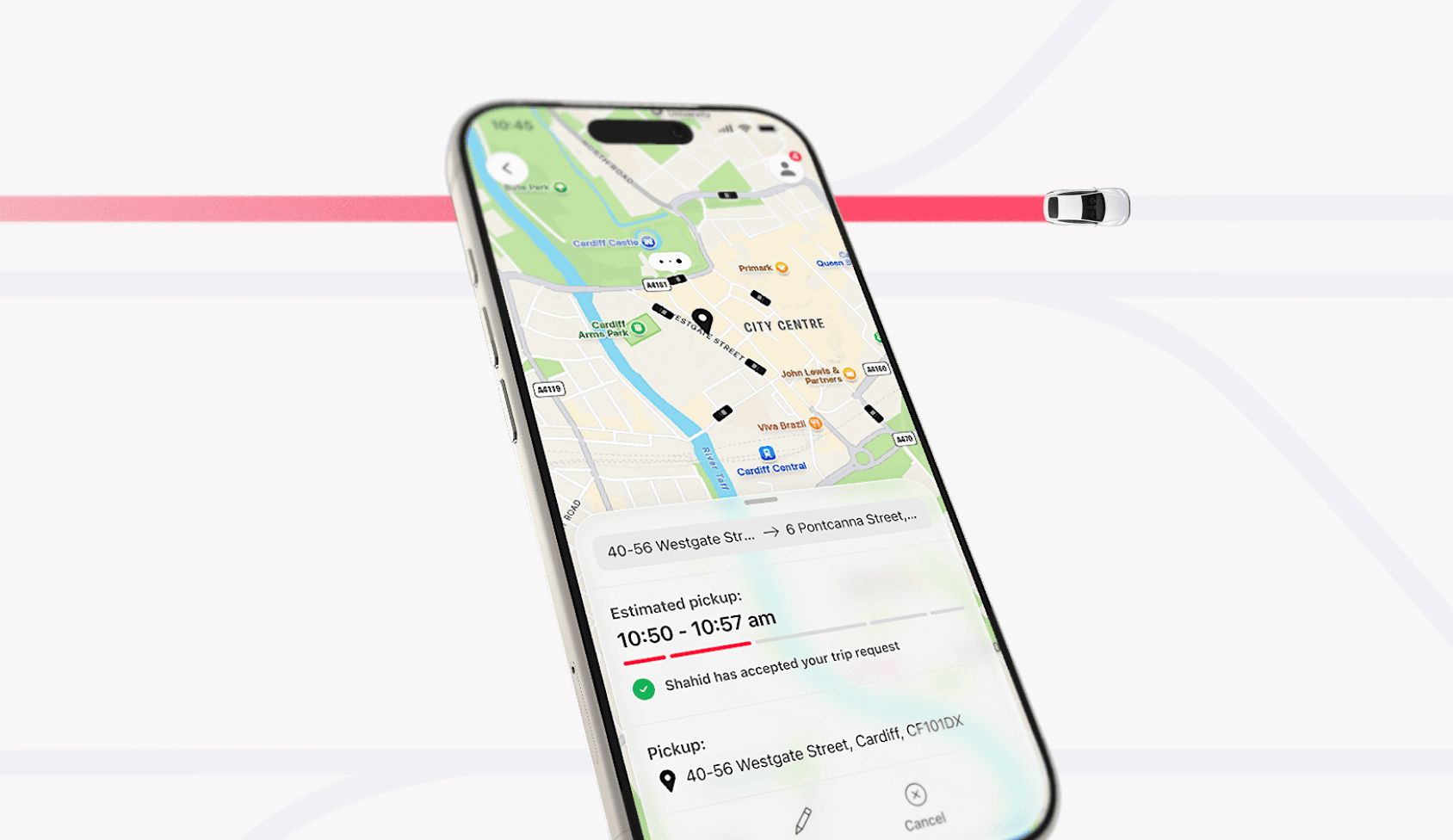
We introduced an estimated pickup window to set clearer expectations from the start
Reducing uncertainty
Using iCabbi’s ETA data, we applied zone-specific buffers to account for the average time needed to find and assign a driver. This gave passengers a more realistic range for when their car would arrive, rather than a single ETA that could later change. We also added a contingency buffer for when the pickup window expired or the upper estimate was exceeded.

A speech bubble hovered above the driver, giving the passenger visual feedback that their request was being reviewed
Hailing a cab
I wanted the experience to feel like hailing a cab in the real world by creating a conversation between the passenger and driver. The journey would reflect the natural moments between them: a driver receiving and responding to the request, the passenger knowing who had accepted the job, and seeing when their driver was on the way to pick them up.
By making these moments visible, we made the experience feel more familiar, helping build trust and reduce cancellations by reassuring passengers that a driver was on the way.
The final experience brought each moment of the journey together, from booking to arrival.
Impact
Together, these changes transformed an unclear waiting experience into a more reassuring journey. Passengers could see what was happening, understand what would happen next, and know when their driver was on the way.
The result was a 10% reduction in cancellations, while waiting time issues fell from multiple daily support requests to just 1 every 2 weeks.
Constraints
I couldn’t redesign the entire experience from scratch. The team was preparing for a new design system and code restructure, so we focused on improving specific components that could be introduced without disrupting the wider rollout.
Some of the experience also depended on backend changes. We needed new endpoints to expose when drivers accepted or declined a request, which meant we had to release the experience in two phases as the required data became available.
Working within these constraints meant balancing the ideal experience with what could realistically be delivered in a 2 week sprint — improving the journey incrementally while laying the groundwork for what came next.

Design QA with our engineers testing beta versions with an AI virtual journey simulator
What I learned
Not every state needs to be visible:
Mapping the entire system helped us understand what was happening, but not every state was useful to passengers. The best experience came from surfacing the moments that actually helped them understand what was happening next.
Accuracy has limits:
Predicting a pickup window was much harder than expected. Multiple variables could change at the same time, from driver availability and response times to location and traffic. A precise estimate wasn’t always possible.
Feedback can be more valuable than precision:
We learned that passengers didn’t always need an exact update — they needed reassurance that something was happening. Showing that we were actively searching, finding and assigning a driver helped make the uncertainty feel more manageable.
© 2026 Daniel Hermoso
